Raising Monarchs

4

Chrysalides

When transformation is complete, the chrysalis will appear a uniform light green, accented with a delicate gold band near the top and other faint gold spots. It hangs from a black stem-like structure (cremaster), attached to the silk webbing it spun (here on the inside top of a netting enclosure).

x

Early Chrysalis Care

Once your caterpillar has transformed into a green chrysalis, allow it at least 24 hours to fully dry and harden before attempting to relocate it to a more suitable habitat.

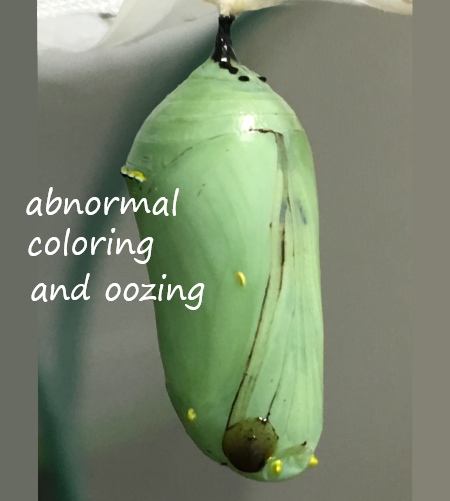
If a chrysalis doesn't fully form or shows unusual coloring, something may not be right. Do not hang this chrysalis with others. Keep a close eye on all chrysalides - any discoloration or oozing is a warning sign. If this occurs, separate the healthy chrysalides from the affected one. Should the chrysalis continue to show abnormal signs, this is the time when euthanizing may be the best option. (Check the Disease and Prevention section of the Getting Started page.) It could emerge deformed, never emerge at all, or appear mostly normal but still carry the risk of infecting other Monarch butterflies.

On a side note: If a bit of the caterpillar’s shed skin remains clinging to the top of the chrysalis because it couldn’t quite wiggle free of it, that’s okay. You can leave it as is, or - once the chrysalis has fully hardened - gently brush it off. Most agree its best to just leave it alone as it has no negative impact on the butterflies emergence.

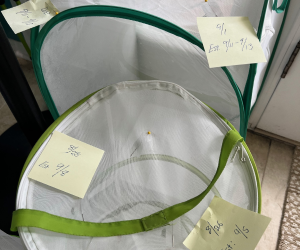
Chrysalides will remain in this stage for approximately 10 to 14 days. I always date mine with a Post-it note on the day they form, along with an estimated emergence date. This is very useful in planning for their emergence.

There have been times when I had to travel right around an expected emergence date, so I’ve taken the chrysalides with me - just in case they emerged while I was gone and needed to be released. Another option would be to enlist a knowledgeable “babysitter” who can watch for them to emerge and understands how to release a butterfly properly.

Relocating a Chrysalis

Once the chrysalis has hardened, it is safe to relocate to a netted habitat. If another caterpillar in the container is already hanging in the J position and preparing to transform, it’s best to leave everything undisturbed until that caterpillar also becomes a chrysalis. If a second caterpillar is still eating and not yet ready to transform, you can remove the lid, relocate the chrysalis, and then replace the lid so the other caterpillar can continue its eating phase.

There are several methods for relocating and reattaching a chrysalis. Personally, I have found the taping technique to be the easiest and most reliable. As explained earlier, the caterpillar will move to the top of the container and weave a small patch of silken webbing on the lid. This is what the chrysalis hangs from by that visible “black stem.” The webbing is surprisingly strong—almost cottony in texture—and usually spreads out farther than the chrysalis itself.

Although the chrysalis may look delicate, it is pretty sturdy and can be relocated safely with careful handling.

My preferred method for relocating is shown in the gallery below. Tap/click the images to enlarge.

Among those who raise monarchs, using small pieces of tape to relocate a chrysalis has become a common method because it allows the chrysalis to be moved with minimal handling. By attaching tape to the silk pad just alongside the cremaster and securing the tape to a new surface, the chrysalis can be safely rehung without touching or stressing the casing itself.

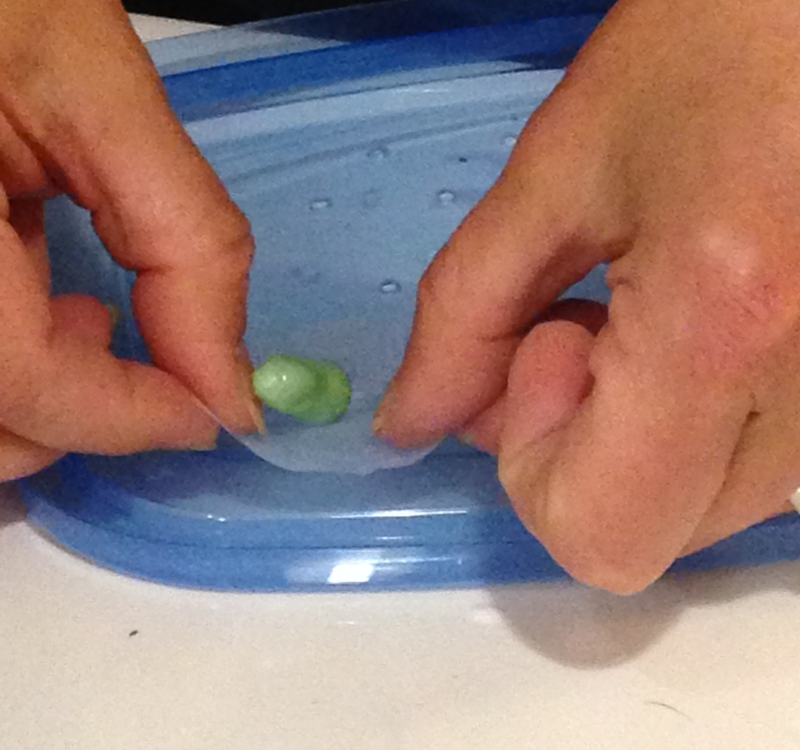
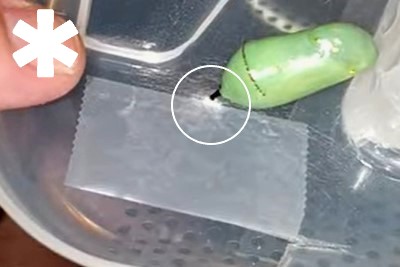
To prepare for relocation, I use Scotch tape both for lifting the chrysalis from the container lid and for hanging it inside the netted enclosure. Gently turn the lid upside down so you can access the chrysalis (it will naturally fall to one side). 1 Cut a strip of tape about two inches long and carefully place it alongside the black stem on one side. Be sure NOT to place the tape directly on the black stem - only next to it, not covering it.

Attach a second strip of tape. Gently move the chrysalis so it leans toward the opposite side, then 2 place another piece of tape along the other side of the black stem. The goal is to attach the tape to the silken webbing that supports the chrysalis. When you 3 gently lift both pieces of tape at the same time, 4 the webbing will come away with it. Once the chrysalis is free from the container lid, 5 press the sticky sides of the tape together so you are holding the chrysalis securely.

This method has also worked when I had one chrysalis on the bottom of a large leaf.

Securing inside the netted enclosure: Holding the chrysalis gently by the tape, bring it to the top of your netted enclosure. Keep it steady against the netting and 6 use a safety pin or straight pin to seure it. Make sure the chrysalis is hanging naturally, with space for it to emerge and expand its wings.

Label each chrysalis. Don’t forget to 7 attach a small tag to the netting showing the estimated emergence date. If you are raising multiple chrysalides at once, each one may emerge at a different time, so labeling helps keep track.

Arrange for enough space. I use two sizes of netted enclosures. The larger one comfortably holds about six chrysalides, while the smaller holds three to four. Avoid overcrowding... the butterflies need room to hang, expand their wings, and crawl around when they emerge. Leave a good amount of space between each pinned chrysalis.

Prepare the bottom of the enclosure. Line the entire bottom on the enclosure with paper towels. I’ll explain the reason for this in the next section.

Now we wait, and count the days.

Emergence

As the days pass and the emergence date gets closer, you’ll begin to notice changes in the chrysalis. The outer shell gradually becomes more translucent, and if you look closely, you might see the faint outline of wings inside.

The day before emergence, the chrysalis appears almost black. It isn’t actually black - the shell has simply become completely transparent, revealing the Monarch butterfly’s wings, colors, and details all folded up inside.

At this point, the butterfly will usually emerge within about 24 hours.

Emerging happens fairly quickly and can be easily missed. There were times when I checked on them, stepped away for a moment to answer the door, and when I came back, they were already out. If you want to witness it, place the enclosure close to where you're working and keep glancing over at it.

You may notice the chrysalis changing shape slightly and elongating. This is the start of the butterfly pushing its way out of the bottom of the chrysalis. They emerge head and legs first and immediately grab onto the empty chrysalis shell. Then their large abdomen slides free. At this point they look a little unusual, with a large dark abdomen and small, wrinkled wings.

Over the next few hours, the butterfly will hang from the chrysalis while slowly pumping fluid from its abdomen into the veins of its wings. This fluid, called hemolymph, helps expand and shape the wings as they grow to their full size. During this time, you will see what I often describe as the butterfly “breathing” with its wings, gently pulsing them in and out. Gradually, the wings become longer, smoother, and fully formed.

Once the wings have reached their full size, the butterfly releases the excess fluid from its body. The droplets fall to the bottom of the enclosure, which is why placing paper towels underneath is helpful for keeping the netted enclosure clean. The liquid may look like a small red or rust-colored spot, similar to a drop of blood. This is a normal part of the process and nothing to be concerned about.

Monarch butterfly

Releasing Your Monarch Butterfly

I allow several hours (4-5) for them before attempting release. Those wings need to be dry and strong so they can fly. I want to see them leave the chrysalis and venture around the netted enclosure and exercise their wings.

Once they’re actively moving and flapping around the enclosure, it’s time to consider release — if conditions are right. That “if” matters. Do not release them in the rain or in temperatures below 70°F. Avoid high winds, and never release them at night. If the weather isn’t cooperating, it’s better to wait than risk a failed first flight.

Fortunately, monarchs can go at least 24 hours without feeding after they emerge. That gives you a little flexibility when conditions aren’t ideal.

There have been times — especially with the 4th generation butterflies emerging in September — when cooler temps and earlier sunsets made the release timing difficult. In those situations, I had to hold them longer than 24 hours. When that happens, I add nectar flowers inside the enclosure using florist tubes set into foam. This at least supplies them with some nourishment until they can be safely released.

When you’re ready to release, take them to a sunny, sheltered location (ideally near your garden) and out of direct wind.

At that point, you can simply open the enclosure and let them find their own way out… or offer a little assistance. If there are multiple butterflies at different stages of readiness, helping one at a time is often best so the others aren’t disturbed while they’re still drying.

A simple method is to gently place your finger just in front of them — similar to coaxing a bird to step up. They’ll often release their grip on the netting and climb onto your finger. From there, slowly move your hand out of the enclosure, and in many cases, they’ll take off on their own. Move too quickly, though, and they may lift off before you’re ready...sometimes ending up right back inside. I’ve had moments where it took a few tries just to get them to stay put long enough to make it out. Once outside, if they don’t fly off right away, take the opportunity to admire their beauty up close. Then simply place your finger near a flower head and let them step onto it.

If one seems reluctant to leave the enclosure — and it’s been at least 12 hours since emerging (giving their wings time to fully dry and strengthen) — there are a couple of other gentle methods you can use.

One option is to carefully cup your hand around them, wings and all, almost like you’re holding a delicate cotton ball. Their legs have tiny hooks that allow them to cling tightly to surfaces, so if you're removing them from the netting, you’ll need to ease them off slowly... and with care. Once free, bring your hand out, turn it over, and gently open it.

Another method is to lightly grasp them while their wings are closed - similar to holding a thin piece of paper between your fingers. Again, slow and gentle is important when releasing their grip from whatever they’re holding onto. You want to protect both their legs and their wings.

And there you have it... one of nature's most amazing transformations. Thank you for allowing me to share this with you, whether you’re just here to learn more about the process or thinking about starting your own journey with the amazing Monarch butterfly.

Monarch chrysalis